
Rupee hits more than two-year low; RBI intervenes

Falling for the fourth day in succession, the rupee today dipped by 23 paise to close at nearly three-week low of 59.38 against the dollar amidst the RBI announcing an SLR cut that is expected to release nearly Rs 40,000 crore into markets.

After two weeks of buying, FPIs turned net sellers in Indian equities this week, with a net withdrawal of Rs 976 crore amid a strengthening US dollar and steady rise in US 10-year bond yields, impacting investor sentiment. Foreign Portfolio Investors (FPIs) began the week on a positive note, investing Rs 3,126 crore in equities during the first two trading sessions (December 16-20).

India, which imports over 80 per cent of its oil needs, spent $87.7 billion on importing 220.43 million tonne (MT) of crude oil in 2017-18. For 2018-19, the imports are pegged at almost 227 MT.

Following alterations in the tax structure, mutual fund (MF) schemes that invest in overseas securities have experienced a sharp decline in inflows. In the first five months of 2023-24 (FY24), international MF schemes have received an average monthly gross inflow of only Rs 270 crore, compared to Rs 490 crore during the same period in the previous year. This decline persists despite nearly all fund houses opening subscriptions for such schemes, with higher redemptions creating headroom for fresh investments.

A weak rupee, though seemingly good for exporters, would push up input cost further for Indian companies.

The Reserve Bank of India's (RBI's) outstanding net forward purchases of US dollars fell by more than 50 per cent from the last quarter of FY22 to $30.86 billion in the June quarter (Q1). The net forwards position was at $65.79 billion at the end of the last fiscal year. The purchases fell by $18.33 billion in June as the central bank intervened in both the forwards and the spot market in order to protect the rupee from excessive depreciation in the face of a widening trade deficit.

The rupee depreciated further by 7 paise to 65.12.

The depreciation in the yuan has led to a decline in all emerging market currencies
.jpg)
The rupee gained 8 paise to close at over two-week high of 61.23 against the US dollar in the previous session.

Foreign portfolio investors' (FPIs') net investment in the domestic debt market in October was the third highest during the current calendar year as foreign investors rushed to lock in higher returns amid global uncertainty and geo-political tensions, market participants said. FPI inflows in debt stood at Rs 6, 322 crore in October against Rs 768 crore in September, according to data on the National Securities Depository Limited (NSDL). Market participants said that the majority of the inflows were channelled through corporate bonds.

Double whammy for consumer firms, where the top line will remain subdued due to demonetisation and margins will squeeze owing to a crude oil spike and rupee depreciation, reports Viveat Susan Pinto/Business Standard from Mumbai.

The stronger than expected monsoon has not yet softened food inflation as much as it should have and in particular, vegetable prices have been impacted by weather-driven supply disruptions, said RBI Governor D Subbarao while unveiling the first quarter monetary policy review.

All sectoral indices ended lower. BSE Telecommunication tanked 2.18 per cent, metal (1.77 per cent), auto (1.70 per cent), energy (1.64 per cent), oil & gas (1.59 per cent), commodities (1.39 per cent) and financial services (1.37 per cent) were the major laggards.

The rupee fell by 49 paise to close at 81.89 (provisional) against the US dollar on Monday as heavy selling pressure in the domestic equities and a spike in crude oil prices weighed on the local unit.

Lok Sabha Speaker Om Birla on Monday warned members against referring to anyone's caste and religion in the House after a Congress MP alleged that Finance Minister Nirmala Sitharaman made certain remarks about his proficiency in Hindi because he belonged to a lower caste.

The report further pointed out that the current rupee volatility will be 'less damaging than in 1991, when low reserves and a widening current account deficit prompted India's last balance of payment crisis'.

Rupee depreciation and a slowdown in capital inflows make it harder for business to service liability, while keeping pressure on the currency.
.jpg)
The BofAML report said that five year money can be raised by issuing the 7 to 9 per cent coupon bonds to stabilise markets, just as it was done in 1998 and 2001.

The Indian rupee on Monday reacted downwards by 12 paise to log nearly one-week closing low of 63.41 against the Greenback.
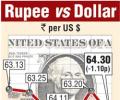
The local currency recovered some ground after the Reserve Bank of India (RBI) was said to have stepped in through state-run banks, helping the rupee to end at 64.30, a fall of 110 paise or 1.74 per cent.
.jpg)
It also painted a grim possibility of any major gains in the rupee during the current fiscal saying that the continuing global volatility, and domestic political uncertainty ahead of the 2014 hustings will limit chances of any significant appreciation apart from further impact growth.

There was a massive 24% decline in India's gems and jewelry exports to $2,321 million for September 2018 as against $3,053.38 million in the same period last year.

The rupee has depreciated 10.5 per cent against the dollar this year, making it Asia's worst-performing currency.

Extending its losing streak for the fourth straight day, the rupee weakened by five paise to 61.01 against the US dollar in early trade today at the Interbank Foreign Exchange market on high demand for the American currency from importers.

In the currency markets, the rupee lost another 10 paise to close at 1-week low of 63.54 against the US dollar

If the REER is to be restored to its 2004-05 level, the rupee has to depreciate a lot, says V K

India's rupee is likely to remain under pressure due to high prices of crude oil and other commodities, and may stabilise at around 79-80 against the US dollar in the near term, say experts amid limited headroom available with the Reserve Bank to check the weakening of the domestic currency. The currency has slumped over 5 per cent this year after Russia's invasion of Ukraine sent international crude oil prices soaring to a decade high. On Monday, rupee ended at a fresh all-time low of 78.34 (provisional) against the US dollar.

India's foreign exchange reserves declined in the week that ended on April 12, after having risen for the seventh straight week to hit an all-time high of $648.56 billion. As per the latest data released by the Reserve Bank of India (RBI), the country's foreign exchange kitty declined by $5.40 billion to $643.16 billion in the April 12 week. India's foreign currency assets (FCA), the biggest component of the forex reserves, declined by $6.51 billion to $564.65 billion, the central bank's weekly statistical data showed.

As the Indian currency hovers around its lowest versus the US greenback, several smaller and mid-sized companies are expected to face rough weather as almost 44 per cent of the foreign loans taken by Indian companies remained unhedged. According to the data sourced from the Reserve Bank of India, Indian companies raised around $38.2 billion in the financial year ended in March. Of this, only 56 per cent of the loans are hedged while the rest of the foreign loans remain unhedged, thus risking the companies to forex volatility.

Falling for the second day, the rupee on Friday weakened by 12 paise against dollar to end at 62.68 weighed down by demand for the American currency from importers and data showing fiscal deficit crossed 95 per cent of the annual target during April-December.

Indian rupee appreciated by 35 paise to end at two-week high of 63.03 against the greenback.

Indian rupee is likely to test 76-76.50 levels as a relatively strong greenback, boiling crude prices and COVID headwinds deepen the depreciation bias for the domestic currency, according to experts. One of the significantly-hit Asian currency in recent months amid uncertain economic times, rupee is expected to see a consolidation in the vicinity of the current level before being pulled towards the depreciation bias. While the equity market has been surging with occasional blips, the rupee has mostly been weak against the US dollar in recent months.

Apart from the emotional value attached to buying gold, the yellow metal offers protection against inflation, interest rate spikes, currency and geopolitical risks, says Anamika Pareek.

Rupee down 13 paise to 66.72 against dollar

Some leading Indian companies are likely to see their earnings declining if the Indian currency depreciates further, analysts and finance heads say.

Following are the highlights of the Economic Survey 2022-23 tabled in Parliament on Tuesday

With India's imports exceeding exports, weak rupee does more harm than good. Analysts, however, say that rupee depriciation is positive for export-oriented sectors such as IT services, pharmaceuticals, textiles and automobiles

Investors in international funds should have a horizon of more than five years. Not only will this help them overcome equity and currency volatility, it will also help them enjoy better tax treatment, says Sanjay Kumar Singh.

Given the prevailing uncertainties, investors must maintain a 10-15 per cent allocation to gold in 2023.
